


Most people who struggle with their mental health don’t reach out for help right away. A 2024 nationally representative survey of 5,149 adults found that nearly a third of people experiencing near-daily depression or anxiety symptoms had never spoken to a healthcare provider about it — despite most saying they would benefit from support.
If you’ve been putting off this conversation — because you don’t have the right words, you’re not sure your symptoms are “serious enough,” or you simply don’t know what to expect — this post is for you. You don’t need a diagnosis or a polished explanation. You just need to know how to start.
Why This Conversation Is Hard — and Why It’s Worth Having
The barriers are real. Fear of judgment, uncertainty about what to say, and the sense that struggling is “just stress” keep millions of people from raising mental health concerns with their doctors.
But most primary care providers are trained for this conversation. They’ve heard it before. And raising the topic doesn’t commit you to anything — it opens a door to understanding what’s actually going on.
The conversation doesn’t need to be perfect. Your doctor doesn’t need a polished story. They need patterns, duration, symptoms, and impact on your daily life.
For a brief overview of how to approach the conversation — including what to expect and how to prepare — the video below from NIMH offers useful guidance before diving into the practical steps:
Before the Appointment: How to Prepare
The infographic below summarizes the three preparation steps, opening sentences that work, and questions worth asking your doctor — a quick reference before your next appointment:
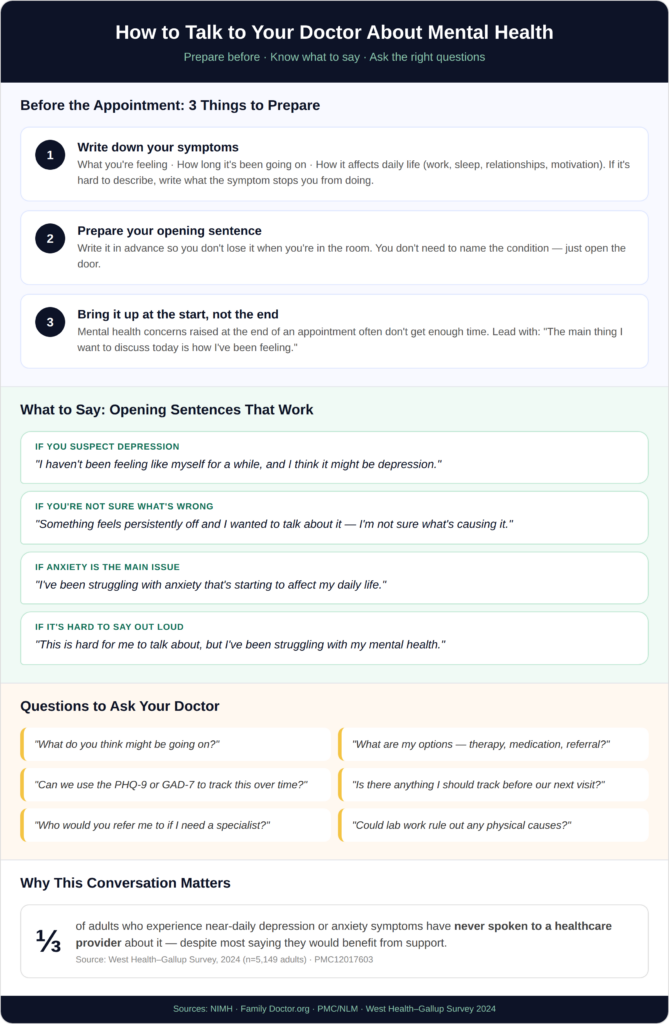
Write down your symptoms before you go
You don’t need medical language. Write in your own words:
- What you’re feeling — low mood, anxiety, numbness, irritability, exhaustion
- How long it’s been going on — days, weeks, months
- How it’s affecting daily life — work, sleep, relationships, concentration, motivation
- Whether anything makes it better or worse
A practical tip: if a symptom is hard to describe, write what it stops you from doing. “I haven’t been able to concentrate at work” is more useful than “I feel foggy.”
Prepare your opening sentence
Write it in advance so you don’t lose it in the room. A few that work:
- “I haven’t been feeling like myself for a while, and I think it might be depression.”
- “I’ve been struggling with anxiety that’s starting to affect my daily life.”
- “I’m not sure what’s going on, but something feels persistently off and I wanted to talk about it.”
- “This is hard for me to say, but I’ve been struggling with my mental health.”
You don’t need to name the condition correctly — that’s the clinician’s job. You just need to open the door.
Bring it up at the start, not the end
Mental health concerns raised at the end of an appointment often don’t get enough time. If this is what you most need to discuss, lead with it: “The main reason I’m here today is to talk about how I’ve been feeling mentally.”
During the Appointment: What to Say and What to Expect
Be specific about duration and impact
“I’ve been feeling anxious” is less useful than “I’ve been having difficulty sleeping three or four nights a week for the past two months, and I’ve started avoiding situations that didn’t bother me before.” Specificity helps your doctor understand severity, pattern, and whether what you’re describing meets clinical criteria.
Mention physical symptoms too
Mental health conditions frequently show up in the body. Fatigue, headaches, digestive issues, changes in appetite, muscle tension, and chest tightness are all worth mentioning — even if you’re not sure they’re connected.
Ask direct questions
You’re entitled to information. A few questions worth having ready:
- “What do you think might be going on?”
- “What are my options — therapy, medication, or referral to a specialist?”
- “Can we use the PHQ-9 or GAD-7 to track this over time?”
- “Is there anything I should track before our next appointment?”
- “Who would you refer me to if you think I need a specialist?”
- “Could lab work rule out any physical causes for what I’m experiencing?”
What Happens After You Bring It Up
Your doctor may use a standardized screening tool — the PHQ-9 for depression or GAD-7 for anxiety — to quantify what you’re experiencing and track it over time.
From there, next steps might include:
- A referral to a therapist, psychiatrist, or psychiatric nurse practitioner
- A discussion of medication options if symptoms are significant
- Lab work to rule out medical causes — thyroid dysfunction, vitamin D deficiency, and iron-deficiency anemia can all produce symptoms that look like depression or anxiety
- A follow-up appointment to monitor how things develop
If your primary care provider doesn’t feel equipped to help, asking for a referral is appropriate: “I think I might need someone who specializes in this. Can you refer me?”
If You Want to Continue the Conversation
Sometimes one appointment isn’t enough to fully address mental health concerns — especially if time is limited or the topic feels complex. A few ways to keep the conversation going:
- Ask for a follow-up appointment specifically focused on mental health: “Can we schedule more time to explore this further?”
- Ask about next steps: “Is there a specialist you’d recommend I see?”
- Consider telehealth as a complement — many mental health providers offer direct access without requiring a referral from your primary care provider.
The goal is to find a care setting where you feel heard and supported. That may be with your current provider, a specialist, or an integrated care team..
When Going Directly to a Mental Health Specialist Makes Sense
For some people, going directly to a mental health specialist makes more sense — particularly if:
- Symptoms are severe or have been going on for a long time
- You’ve already seen a primary care provider without resolution
- You want a psychiatric evaluation that looks at the full picture
- You’re interested in an integrated approach that combines psychiatry, therapy, nutrition, and exercise
Telehealth has made this more accessible. Many psychiatric and therapy practices accept direct appointments, often with shorter wait times than traditional referral pathways.
Ready to Take the First Step?
You don’t have to wait until you have the right words. At Modyfi, you can book directly with our network of providers without needing a referral. At Modyfi, our Root-Cause Psychiatry approach brings psychiatry, therapy, nutrition, and exercise together in one coordinated plan — so your care addresses the full picture, not just one piece of it.
👉 Explore Providers to Book an Appointment and Start Your Care Plan
(Note: Modyfi proudly accepts most major commercial insurance plans. We do not accept Medicare or Medicaid.)
Conclusion: The First Sentence Is the Hardest Part
Starting a mental health conversation with your doctor is often harder in anticipation than it turns out to be in practice. Most clinicians are trained for it, prepared for it, and glad when patients bring it up — because unaddressed mental health concerns affect physical health, daily functioning, and relationships in ways that make every other aspect of care harder.
But the conversation itself is just the first step. What comes after — finding the right provider, building a care plan, adjusting it over time — matters just as much. Good mental health care is rarely a single appointment or a single decision. It’s a process that works best when you stay engaged, ask questions, and advocate for what you need along the way.
The research is clear: people who receive coordinated care — where psychiatry, therapy, nutrition, and lifestyle support work together around a shared plan — tend to do better than those whose care is fragmented across providers who don’t communicate.
Certainty isn’t required. Neither is the right diagnosis. All it takes is one sentence that opens the door — and the willingness to stay in the room once it does.
Frequently Asked Questions
What if I don’t know what’s wrong — can I still bring it up?
Yes — and you don’t need to arrive with a self-diagnosis or a polished explanation. “I don’t know what’s wrong, but something feels persistently off” is a completely valid opening for a mental health conversation with your doctor.
What’s most helpful is describing what you’ve been noticing in practical terms: how long it’s been going on, what it feels like day to day, and how it’s affecting specific areas of your life — work, sleep, relationships, concentration, or motivation. If you find the feeling hard to put into words, try describing what it stops you from doing rather than what it is. “I haven’t been able to enjoy things I used to” or “I’ve been struggling to get through the workday” gives your doctor more to work with than a general sense that something is wrong.
You’re not expected to diagnose yourself. That’s the clinician’s job. Your job is to open the door — and any honest description of your experience is enough to do that.
Will my doctor judge me for bringing up mental health?
Concerns about judgment are one of the most common reasons people delay mental health conversations — but in practice, most primary care providers are trained to respond to these concerns with care rather than judgment.
Mental health is a routine part of primary care. Many providers routinely screen for depression and anxiety using standardized tools like the PHQ-9 and GAD-7. Bringing it up yourself isn’t unusual or alarming — it’s exactly what providers want patients to do, and most will respond by asking follow-up questions, conducting a brief screening, and discussing next steps.
If you do encounter a provider who seems dismissive or rushed, that’s worth noting — but it reflects on the fit with that particular provider, not on the validity of your concerns or your decision to raise them. In those situations, asking for a longer dedicated appointment or requesting a referral to a mental health specialist are both reasonable responses.
Do I need a referral to see a psychiatrist or therapist?
Not always — and this is one of the most common misconceptions that delays mental health care.
Many mental health practices, including telehealth platforms, accept direct appointments without requiring a referral from a primary care provider. This is particularly true for therapy — most licensed therapists and counselors accept self-referrals directly. For psychiatry, the process varies more by practice and insurance plan.
If your insurance plan does require a referral, your primary care provider can typically provide one after a brief conversation about your symptoms. It’s worth calling your insurance company before the appointment to understand what your plan covers and whether a referral is needed — asking specifically about mental health benefits, which are sometimes administered separately from medical benefits.
Telehealth has significantly reduced the access barriers that once made this process harder. Many psychiatric and therapy practices now offer same-week appointments virtually, without the wait times associated with traditional in-person care.
What screening tools might my doctor use?
The two most commonly used tools in primary care settings are the PHQ-9 and the GAD-7.
The PHQ-9 (Patient Health Questionnaire) is a nine-question tool that screens for depression. It asks about symptoms like low mood, loss of interest, sleep changes, fatigue, and difficulty concentrating over the past two weeks. Scores range from 0 to 27, with higher scores indicating more significant symptoms. Many providers use it at routine appointments as a baseline, and again over time to track progress.
The GAD-7 (Generalized Anxiety Disorder Scale) is a seven-question tool that screens for anxiety. It asks about worry, restlessness, irritability, and difficulty relaxing. Like the PHQ-9, it takes about two minutes to complete and gives your provider a standardized starting point.
You don’t have to wait for your doctor to administer these tools. Both are freely available online — filling them out before your appointment and bringing the results can help focus the conversation and give your provider useful information before you sit down together.
What if my doctor recommends medication but I’m not ready for that?
You’re entitled to decline or ask for more time before deciding — and a good provider will respect that while making sure you have the information you need.
It helps to be direct about where you are: “I’d like to understand more about what you’re recommending before I decide” or “I’d prefer to start with therapy and revisit medication if that isn’t enough.” Most providers will explain the rationale behind their recommendation, discuss alternatives, and give you space to process the decision.
It’s also worth understanding that medication for depression and anxiety isn’t necessarily a permanent commitment. Many people use medication for a defined period — particularly during an acute episode — and then taper off with clinical support. Others find that medication makes therapy more effective by stabilizing mood enough to engage with the work. These are nuances worth discussing with your provider rather than deciding for or against medication in the abstract.
What’s important is that the decision feels informed and collaborative — not something that happened to you in a 15-minute appointment.
How do I prepare if I have trouble talking about emotions in person?
Writing it down in advance and handing it to your doctor at the start of the appointment is a completely valid approach — and more common than you might think. You can write a brief summary of what you’ve been experiencing, how long it’s been going on, and what you’re hoping to get from the conversation. Handing it over at the start gives the provider context without requiring you to say it out loud cold.
A telehealth appointment may also feel less intimidating than an in-person visit for some people — the physical distance and the option to be in your own space can lower the activation energy of starting a difficult conversation.
Some people also find it helpful to fill out a PHQ-9 or GAD-7 online before the visit and bring the printed results. Showing rather than telling can bypass some of the difficulty of explaining feelings verbally.
Finally, if you feel yourself shutting down during the appointment, it’s fine to say so: “I’ve been finding this hard to talk about — I wrote some things down if that helps.” Most providers appreciate the honesty and will work with you from there.