


REM sleep is more than just dreaming – it’s when your brain processes emotions, manages stress, and strengthens memory. Without enough REM sleep, you risk emotional instability, poor memory, and even long-term health issues like dementia.
Here’s why REM sleep matters:
- Emotional Recovery: Your brain revisits memories, softens emotional distress, and builds resilience.
- Stress Regulation: REM sleep lowers stress chemicals like norepinephrine, allowing emotional “cooling.”
- Memory Strengthening: It helps retain facts while reducing emotional weight tied to experiences.
- Health Risks of Disruption: Poor REM sleep links to mood disorders, anxiety, and even pain sensitivity.
Simple ways to improve REM sleep:
- Stick to a consistent sleep schedule.
- Avoid alcohol and screens before bed.
- Keep your bedroom cool (below 68°F).
- Practice relaxation techniques like journaling or mindfulness.
If you’re waking up groggy or emotionally drained, your REM sleep might be disrupted. Addressing this can significantly improve your emotional and mental health.
The Science of REM Sleep
What Makes REM Sleep Different
Every night, your body cycles through three NREM stages and one REM stage about 4–6 times, with each cycle lasting roughly 90 minutes.
What sets REM sleep apart is its heightened brain activity. This stage is marked by rapid eye movements, vivid dreams, and temporary muscle paralysis, which prevents you from physically acting out your dreams. Interestingly, as the night progresses, REM periods grow longer, playing a key role in emotional processing.
Now, let’s dive into the brain chemistry that makes REM sleep so unique.
Brain Chemistry and Activity During REM Sleep
REM sleep operates on a distinctive neurochemical balance that supports emotional regulation and memory processing. During this stage, acetylcholine levels spike – sometimes even surpassing those seen during wakefulness, especially in the hippocampus. Meanwhile, norepinephrine and serotonin levels drop to nearly zero. This combination fuels activity in critical brain areas like the amygdala (key for handling emotions), the hippocampus (essential for memory creation), and the brainstem (which helps trigger REM sleep).
If you were to look at an EEG during REM sleep, you’d notice brain activity resembling that of wakefulness, a sharp contrast to the slow, synchronized waves of deep NREM sleep.
“REM sleep represents a unique brain state that allows the emotionally modulated integration and recombination of neocortical memory traces previously consolidated during NREM sleep.” – Frontiers in Psychology
Why REM Sleep Is Key to Emotional Stability
One of the most fascinating aspects of REM sleep is its role in managing emotions. With norepinephrine levels at nearly zero, the brain can revisit tough memories without triggering a stress response. This ties into the “sleep to forget, sleep to remember” (SFSR) hypothesis, which suggests that REM sleep helps retain the factual parts of a memory while softening its emotional sting. Essentially, it’s like your brain is filing away life’s lessons while easing the emotional weight tied to them. This process is vital for building emotional resilience and handling daily stress.
“Low levels of noradrenaline during rapid eye movement sleep provide a unique window of opportunity for plasticity in neuronal representations of emotional memories that resolves the associated distress.” – Nature Reviews Neuroscience
REM sleep doesn’t just help with emotions – it also fine-tunes your brain for learning by pruning unnecessary neural connections. It’s not just an emotional refresh; it’s a complete cognitive upgrade that happens while you’re asleep.
sbb-itb-23f89d4
REM sleep critical for emotional and mental health
How REM Sleep Builds Emotional Resilience
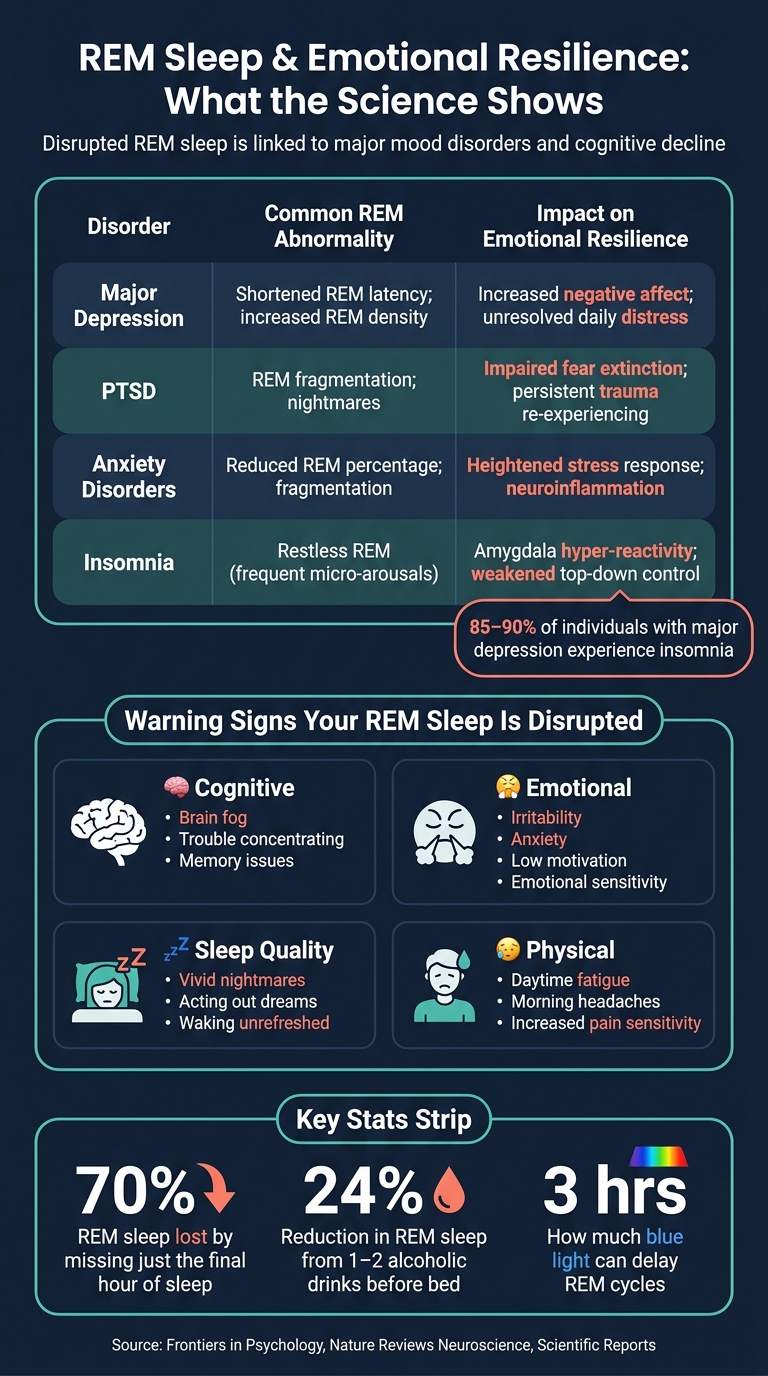
REM Sleep Disruptions: Mood Disorders, Symptoms & Warning Signs
How the Brain Processes Emotional Memories During REM Sleep
During REM sleep, your brain takes on the intricate task of reshaping memories. This phase not only strengthens the factual details of an experience but also helps to ease the emotional sting tied to it. In simpler terms, REM sleep helps you hold onto the “what” of an event while softening the “how it felt” part. This is a cornerstone of how REM sleep supports mental well-being.
This process involves a fascinating interplay between two key brain regions. The hippocampus is responsible for storing the factual aspects of an event, while the amygdala works to tone down its emotional intensity. This coordination happens through theta-band interactions, particularly between the medial prefrontal cortex and the amygdala. These interactions are crucial for fear extinction – essentially teaching your brain that a past threat no longer poses any danger.
“REM sleep performs a dual function: Sleep to Remember (strengthening important facts) and Sleep to Forget (stripping away the emotional blanket from the memory).” – Allen Kanerva, Founder, Inspyrd Inc
Another key mechanism, synaptic depotentiation, helps weaken overly active connections between the amygdala and hippocampus. This reduces the emotional charge tied to distressing memories, leaving those neural pathways refreshed and ready for new learning.
How REM Sleep Regulates Stress
REM sleep is unique because it’s the only time when noradrenaline, a major stress-related chemical, drops to nearly zero. This creates a rare opportunity for the brain to revisit and process emotional experiences without triggering the fight-or-flight response. The result? What researchers call “emotional cooling”, where distressing memories gradually transform into neutral narratives.
“REM sleep acts as a neurochemical bath, reducing stress hormones like noradrenaline. This allows the brain to process the emotional charge of a memory, eventually turning a hot traumatic memory into a cool narrative memory.” – Allen Kanerva, Founder, Inspyrd Inc
During this phase, REM sleep also recalibrates the HPA axis (a system that manages stress) and promotes higher vagal heart rate variability (HRV). This combination shifts the brain’s focus toward neutral or positive information, rather than lingering on negative content. However, this delicate balance depends on uninterrupted REM sleep. Fragmentation of this sleep stage disrupts the amygdala’s overnight adaptation, reducing its ability to process emotional experiences effectively.
REM Sleep Disruptions and Mood Disorders
When REM sleep is disrupted over time, the brain loses one of its most effective tools for emotional recovery. The impact can be profound. A study from 2020 revealed that suppressing REM sleep heightens amygdala activity and weakens connectivity in the anterior cingulate cortex (ACC) – a region critical for managing emotions.
The connection between poor REM sleep and mood disorders is striking. For instance, insomnia is present in 85–90% of individuals with major depression, and poor sleep is a strong predictor for the onset of anxiety (odds ratio 3.23) and depression (odds ratio 2.83). The table below highlights how REM disruptions manifest in various conditions:
| Disorder | Common REM Abnormality | Impact on Emotional Resilience |
|---|---|---|
| Major Depression | Shortened REM latency; increased REM density | Increased negative affect; unresolved daily distress |
| PTSD | REM fragmentation; nightmares | Impaired fear extinction; persistent trauma re-experiencing |
| Anxiety Disorders | Reduced REM percentage; fragmentation | Heightened stress response; neuroinflammation |
| Insomnia | Restless REM (frequent micro-arousals) | Amygdala hyper-reactivity; weakened top-down control |
In conditions like PTSD, elevated norepinephrine levels during REM sleep prevent the brain from properly processing traumatic memories. Instead of transforming these experiences into neutral narratives, the brain replays them through nightmares. This underscores why the quality of REM sleep – not just the total hours of sleep – is so critical for emotional health.
Up next, we’ll look at practical ways to improve REM sleep and support emotional recovery.
How to Improve REM Sleep Quality
Improving REM sleep is key to helping the brain manage emotions and strengthen memory.
Building Better Sleep Habits
REM sleep primarily happens in the last 90 minutes of your sleep cycle. Missing even the final hour of sleep can reduce REM sleep by as much as 70%. This makes sticking to a consistent sleep schedule – one that protects those crucial final cycles – an essential step toward better rest.
Temperature plays a bigger role in sleep than many people realize. Keeping your bedroom below 68°F helps your body lower its core temperature, which is a natural trigger for both deep and REM sleep. Combine this with blackout curtains and a white noise machine, and you’ve created an environment that supports uninterrupted sleep.
Alcohol can seriously disrupt REM sleep. Just 1–2 drinks within three hours of bedtime can decrease REM sleep by up to 24%. While alcohol might make it easier to fall asleep, it suppresses early REM cycles and fragments the later ones. The result? You wake up feeling groggy and emotionally drained. A simple fix: stick to the 4-hour rule and finish your last drink at least 3–4 hours before bed.
Another important factor to consider is how light exposure affects your sleep.
Managing Light and Screen Exposure
Light exposure in the evening can interfere with REM sleep. Blue light from screens delays melatonin production, pushing back REM cycles by up to 3 hours. Avoiding screens for 60–90 minutes before bed gives your brain the time it needs to transition into sleep. If avoiding screens isn’t possible, tools like blue-light blocking glasses or software filters such as Night Shift (on Apple devices) or f.lux (available for Windows and Mac) can help reduce the impact. A study in Scientific Reports found that reducing blue light exposure decreased REM fragmentation from 10.3% to 6.6% and significantly reduced cortical microarousals.
“Evening light environments can be designed to consolidate and increase the duration of REM-sleep.” – Scientific Reports
Morning light is just as important. Exposure to natural sunlight shortly after waking helps regulate your circadian rhythm, which determines when your REM cycles occur later that night.
To further enhance REM sleep, focus on reducing stress before bed.
Using Mindfulness and Relaxation to Sleep Better
High stress before bed disrupts REM sleep. Elevated cortisol levels fragment REM cycles, preventing your brain from processing emotions effectively overnight. A simple solution is a “bedtime brain dump” – spend 5 minutes jotting down a to-do list for the next day. This small habit reduces cortisol levels and quiets the mental noise that can interfere with sleep.
HRV biofeedback is another tool for improving sleep. By boosting vagal tone, it enhances emotional regulation and supports better memory processing during REM.
“Higher HRV signifies a greater potential to transition from a high sympathetic arousal state (e.g., during stressful situations) to a relaxed state.” – Frontiers in Behavioral Neuroscience
Another technique, Imagery Rescripting (ImR), involves revisiting a difficult memory and mentally rewriting it into a more resolved or neutral scenario. Practicing this before bed encourages adaptive memory processing before REM begins. On the supplement side, taking 300–400 mg of Magnesium Glycinate before bed can activate GABA receptors, promoting more stable sleep patterns.
When to Get Professional Help for Sleep and Emotional Health
Getting enough REM sleep is essential for maintaining emotional balance. When REM sleep is disrupted, it can point to deeper sleep or mood-related disorders. While self-help can sometimes make a difference, there are times when the problem goes beyond what a better bedtime routine can fix.
Signs Your REM Sleep May Be Disrupted
If you’re waking up feeling drained even after 7–8 hours of sleep, it could be a sign that your REM sleep isn’t doing its job. Feeling groggy, irritable, or emotionally fragile in the morning often signals poor-quality REM cycles.
Other red flags might include acting out dreams – like talking, kicking, or punching in your sleep. This behavior could indicate REM Sleep Behavior Disorder (RBD) and should be evaluated further. Loud snoring paired with breathing pauses could point to Obstructive Sleep Apnea (OSA), a condition where over half of those affected also meet the criteria for depression. If your mood, memory, or focus is steadily declining and you’re taking SSRIs or SNRIs, it’s worth noting that these medications can suppress REM sleep by 20–50%, potentially worsening emotional challenges. If this sounds familiar, it’s a good idea to bring it up with your doctor.
Here’s a quick breakdown of the warning signs to watch for:
| Symptom Category | Warning Signs |
|---|---|
| Emotional | Irritability, emotional sensitivity, anxiety, low motivation |
| Cognitive | Brain fog, trouble concentrating, memory issues |
| Physical | Fatigue during the day, morning headaches, increased pain sensitivity |
| Sleep Quality | Vivid nightmares, acting out dreams, waking up feeling unrefreshed |
If these symptoms resonate with you, it might be time to seek professional help.
How Modyfi Health Can Help

Instead of navigating your recovery alone, Modyfi Health guides you through a collaborative, step-by-step process. Your journey can begin with a complimentary 15-minute discovery call to explore your needs, which seamlessly leads into a comprehensive medical-psychiatric evaluation to map out your sleep architecture and mental health goals.
By integrating functional lab testing, their expert care team investigates hidden biological roadblocks—such as deficiencies in ferritin, vitamin D, magnesium, or thyroid imbalances—that quietly fragment your sleep and worsen mood symptoms overnight.
Modyfi Health takes a comprehensive approach, combining psychiatric evaluations, therapy, and lab testing to uncover and address the root causes of sleep and mood issues. This includes checking for deficiencies in ferritin, vitamin D, magnesium, and thyroid function, all of which can quietly disrupt sleep and worsen mental health symptoms.
For sleep-specific challenges, Modyfi Health offers Cognitive Behavioral Therapy for Insomnia (CBT-I). This therapy is a gold-standard treatment for stabilizing REM sleep. Research shows that CBT-I can improve mood more effectively than antidepressants, with an effect size of 0.63 compared to 0.30 for medication alone. By tackling both sleep and emotional health together, the results are far better than treating either issue on its own.
👉 Schedule your FREE discovery call with Modyfi Health today to start healing the whole person.
Conclusion: Taking Control of Your REM Sleep for Better Emotional Health
REM sleep plays a critical role in how your brain processes emotions, strengthens memories, and manages stress. This makes improving your sleep habits essential for maintaining emotional balance. Even with 8 hours of sleep, a lack of quality REM sleep can leave you feeling irritable and unable to concentrate.
The good news? Small, consistent changes can make a big difference in improving your REM sleep. Prioritizing uninterrupted sleep is the foundation. As Dr. Priya Nambiar, MD, explains:
“A person sleeping 6.5 high-quality hours with intact REM architecture will often function better than someone sleeping 9 fragmented hours with repeatedly disrupted REM.”
FAQs
How can I tell if I’m not getting enough REM sleep?
Feeling sluggish, mentally foggy, or on edge during the day – even after a full night’s sleep – might point to not getting enough REM sleep. This stage is vital for emotional balance, so you may also notice feeling overly reactive or easily overwhelmed. Struggles with memory, mood, or solving problems can creep in as well. While wearables aren’t flawless, they can track trends in your sleep patterns. If you consistently see low REM readings, it’s worth taking a closer look at your sleep habits.
Does waking up early cut off the most important REM sleep?
Waking up early can cut into your most restorative sleep – REM sleep. REM cycles get longer as the night goes on, with the most impactful phases happening in the early morning hours. Losing just 60 to 90 minutes of sleep can mean missing out on these critical REM periods, which play a key role in managing stress and building emotional resilience.
Which sleep problems most commonly disrupt REM sleep?
REM sleep often gets interrupted by sleep fragmentation, which refers to frequent awakenings or shifts between sleep stages during the night. Insomnia can destabilize REM sleep, causing the brain to misinterpret it as wakefulness. Other factors that can disrupt REM sleep include psychosocial stress, irregular work schedules, overuse of electronic devices, certain medications, and medical or psychiatric conditions, including sleep disorders. These disruptions can impact the quality and continuity of this critical sleep stage.