


Research links low ferritin and ADHD, but ADHD alone isn’t a reason to check iron levels. Ask your clinician about iron testing if you also have persistent fatigue, restless legs, or heavy periods. A restricted diet or past iron deficiency also counts.
Three points help put the research in context:
- Normal hemoglobin doesn’t rule out low iron stores. Ferritin, a CBC, and sometimes transferrin saturation help your clinician assess the results.
- A link isn’t proof of a cause. A 2021 review found ferritin differences in only 10 of 18 studies. Most research involves children rather than adults.
- Iron treats confirmed deficiency, not ADHD. Supplements need medical guidance, follow-up testing, and a check for causes such as blood loss or poor absorption.
Correcting low iron may ease fatigue, but it doesn’t replace ADHD care. Bring your symptoms, diet, bleeding history, and past blood work to your appointment. Don’t start iron on your own.
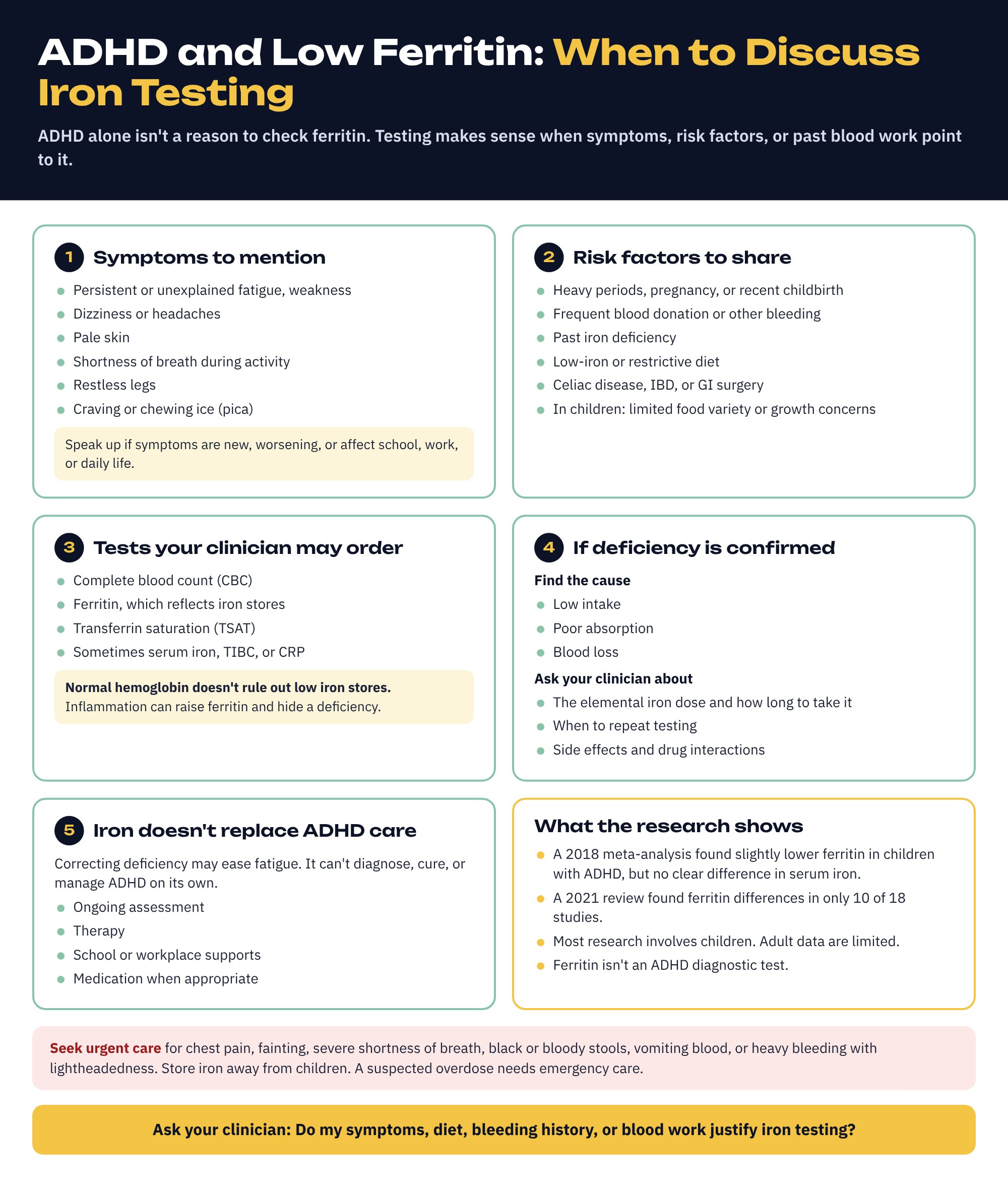
The infographic below shows when to discuss iron testing and what to expect.
What Does Research Say About Ferritin and ADHD?
Systematic reviews and meta-analyses in children report slightly lower ferritin levels in ADHD, but the findings vary. A 2018 meta-analysis compared 1,560 children with ADHD and 4,691 children without it. Ferritin was slightly lower in the ADHD group. Serum iron and transferrin showed no statistically meaningful difference.
A 2021 review found statistically meaningful ferritin differences in only 10 of 18 studies. These results point to an association, not a clear treatment target.
Most of the evidence comes from children. Research in adults remains much more limited. Ferritin reflects the body’s iron stores, but it doesn’t directly measure iron in the brain. Some researchers think brain iron may matter more than blood levels.
A Link Does Not Prove a Cause
Most studies are cross-sectional: they look at participants at one point in time. That means they cannot show whether low ferritin comes before ADHD symptoms. Diet, sleep, health conditions, and medication effects may also explain part of the link.
Studies use different ferritin cutoffs and participant groups. One study’s threshold shouldn’t become a rule for everyone. Ferritin is not an ADHD diagnostic test, and a low result cannot replace a full evaluation. It can help guide care, but it cannot define it.
Why Testing and Iron Treatment Are Not for Everyone
A small 2008 trial studied 23 children, ages 5 to 8, with ferritin below 30 ng/mL. After 12 weeks of iron, their ADHD ratings improved. However, only 5 children received a placebo, which limits confidence in the results.
Other research on iron supplements hasn’t consistently found improvements in ADHD symptoms. If a clinician recommends iron, ask whether the goal is to treat a confirmed deficiency. Also ask how they will track progress. That raises a practical question: when is iron testing worth discussing?
sbb-itb-23f89d4
When Should You Ask About Iron Testing?
Ask about iron testing if you have symptoms or risk factors for iron deficiency. It may identify a treatable cause of fatigue, trouble focusing, or sleep problems.
Symptoms and Risk Factors to Discuss
Tell your clinician about any of these symptoms:
- Persistent or unexplained fatigue or weakness
- Dizziness or headaches
- Pale skin
- Shortness of breath during activity
- Difficulty exercising as much as usual
Restless legs and pica, such as craving or chewing ice, also deserve attention. Speak up if symptoms are new, getting worse, or interfering with school, work, or daily life.
Share any history of heavy periods, pregnancy or recent childbirth, frequent blood donation, other bleeding, or past iron deficiency. Also mention a low-iron diet, restrictive eating, chronic diarrhea, abdominal symptoms, celiac disease, inflammatory bowel disease, or gastrointestinal surgery. For children and teens, discuss limited food variety, restrictive eating, and concerns about growth.
Reasons to Test and Limits to Consider
Heavy menstrual bleeding, restricted food intake, or persistent fatigue and concentration problems are reasons to discuss testing. However, inflammation, chronic illness, sleep disorders, thyroid disease, mood conditions, and medication effects can make the results harder to interpret.
Your clinician may order a complete blood count (CBC), ferritin, and transferrin saturation (TSAT), rather than ferritin alone. Normal hemoglobin does not rule out low iron stores. Ask which tests fit your health history and whether recent illness or inflammation could affect the results.
Bring up these symptoms and risk factors during your visit so your clinician can choose tests and interpret the results in context.
How to Prepare for Your Appointment
Bring past blood work, a symptom timeline, and details about your diet. Also bring a full list of medications and supplements, including any iron you take. Record menstrual bleeding, other bleeding, blood donation dates, sleep changes, and digestive symptoms.
Seek urgent care for chest pain, fainting, severe shortness of breath, black or bloody stools, vomiting blood, or heavy bleeding with lightheadedness.
If testing confirms iron deficiency, your clinician can discuss treatment and investigate the cause.
How Should Iron Results Guide Care?
If your clinician orders testing, look at the full pattern, not ferritin alone. Clinicians read ferritin alongside a CBC and TSAT, using serum iron and TIBC when needed. Low ferritin generally points to depleted iron stores. Serum iron levels fluctuate, so they cannot diagnose deficiency on their own. Inflammation can increase ferritin and hide a deficiency. TSAT and sometimes C-reactive protein (CRP) help put the results in context. If results suggest deficiency, the next step is to find the cause.
Treat Confirmed Deficiency and Find Its Cause
Treat confirmed deficiency while checking for low intake, poor absorption, or blood loss. In adults, unexplained deficiency or anemia may call for a check for gastrointestinal blood loss. This applies especially to men and postmenopausal women. Ask about the elemental iron dose, how long to take it, and when to repeat testing. If deficiency persists, it needs a fresh look at the cause rather than more iron.
Oral iron can cause nausea, constipation, abdominal discomfort, or dark stools. A pharmacist can check for interactions with medicines, antacids, and calcium products. Treating yourself can delay an investigation into bleeding, and excess iron can damage organs. Store iron securely away from children; suspected overdose requires urgent medical attention.
Iron Treatment Does Not Replace ADHD Care
Correcting iron deficiency may ease fatigue, but it cannot diagnose, cure, or manage ADHD on its own. Continue psychiatric assessment, therapy, school or workplace supports, and medication management when appropriate.
Low Ferritin and ADHD: Test Iron When There’s a Clinical Reason
The link between low ferritin and ADHD is real but modest. Symptoms, diet, bleeding history, medical conditions, or blood work should guide iron testing. Use supplements only with medical guidance. Bring this question to your appointment:
“Do my symptoms, diet, bleeding history, medical conditions, or existing blood work justify ferritin testing and broader iron studies?”
Symptoms Are Signals. Let’s Find the Source.
Focus problems, fatigue, and restlessness can have more than one cause. ADHD, low iron, poor sleep, and mood changes often overlap. Modyfi’s network of providers looks at the whole person, drawing on mind-body, functional, and integrative medicine. Your provider can evaluate ADHD and order relevant lab work, such as ferritin, when it fits. Together, you can build a plan around your goals.
👉 Explore Providers to Book an Appointment and Start Your Care Plan
(Note: Modyfi proudly accepts most major commercial insurance plans.)
FAQs
What ferritin level counts as low for me?
There’s no single ferritin level that’s low for everyone. Lab reference ranges differ, and your result depends on age, sex, pregnancy, and health conditions. Research on ADHD has used cutoffs such as 30 ng/mL, but a study threshold isn’t a personal target.
Context also matters. Inflammation or infection can raise ferritin and make low iron stores look normal. For this reason, clinicians often check ferritin alongside a CBC, TSAT, and sometimes CRP.
Ask your clinician what your number means for you, and whether any symptoms or risk factors change the picture.
How soon should I recheck ferritin after treatment?
Ask your healthcare provider when to recheck your ferritin. The timing depends on your starting level, the cause of the drop, and the type of iron treatment.
Follow-up blood work usually includes a CBC along with ferritin. Together, these results show whether iron stores and red blood cells are recovering.
If levels don’t improve as expected, your provider may look for poor absorption or ongoing blood loss. Don’t increase or stop iron on your own.
How can I distinguish iron deficiency symptoms from ADHD?
Difficulty concentrating and low motivation can occur with both iron deficiency and ADHD. Behavior alone can’t tell them apart.
A few clues can help. ADHD symptoms usually begin in childhood and show up across settings, such as home, school, or work. Iron deficiency often brings physical signs too, such as shortness of breath, pale skin, or restless legs.
The two can also occur together. A full ADHD evaluation, plus blood tests when symptoms or risk factors suggest low iron, gives the clearest answer.
Should I take iron supplements for ADHD?
Only if testing confirms iron deficiency. Iron doesn’t treat ADHD itself, and research on iron for ADHD symptoms remains small and inconsistent.
Taking iron without a clear reason can cause side effects, such as constipation or nausea. Too much iron can also build up and damage organs over time.
If testing shows low iron, your clinician can recommend a product, a duration, and a plan for follow-up blood work. Keep iron away from children, since an overdose can be dangerous.
Can low iron cause restless legs or sleep problems?
It can. Low iron stores can contribute to restless legs syndrome. This condition causes an urge to move the legs, often worse at night. That restlessness can disrupt sleep.
Poor sleep can then worsen focus, mood, and irritability during the day. Those effects can look like ADHD symptoms or make existing ones harder to manage.
If you notice restless legs or ongoing sleep trouble, mention it to your clinician. Iron testing may be part of the evaluation.
Which foods are high in iron?
Iron comes in two forms. Heme iron, found in lean meat, seafood, and poultry, absorbs more easily. Non-heme iron comes from beans, lentils, spinach, nuts, and iron-fortified cereals.
Pairing non-heme iron with vitamin C, such as citrus or bell peppers, can improve absorption. Tea and coffee with meals can reduce it.
Diet helps prevent low iron, but it may not correct a confirmed deficiency on its own. Your clinician can tell you whether food changes are enough.