


Rhodiola for fatigue may ease short-term tiredness, but it isn’t a proven treatment for stress, depression, or anxiety. The NIH notes that there isn’t enough reliable evidence to judge its usefulness for any health purpose. If your fatigue persists, seek medical care rather than relying on a supplement. Don’t stop or replace a prescribed medication on your own.
The research comes with four caveats:
- Results vary. Small, brief trials suggest some fatigue relief. That does not mean better mood, sharper thinking, or less stress.
- The extract matters. Findings from specific standardized extracts may not apply to the bottle you buy.
- Safety has limits. Rhodiola is possibly safe for up to 12 weeks, but long-term safety remains unclear.
- Check before use. Discuss your medications with a clinician, especially antidepressants. Use extra caution with bipolar disorder. Safety data are lacking for children and during pregnancy or breastfeeding.
Treat rhodiola as an uncertain option. It doesn’t replace medical evaluation or treatment. The infographic below summarizes what the research supports and where it falls short.
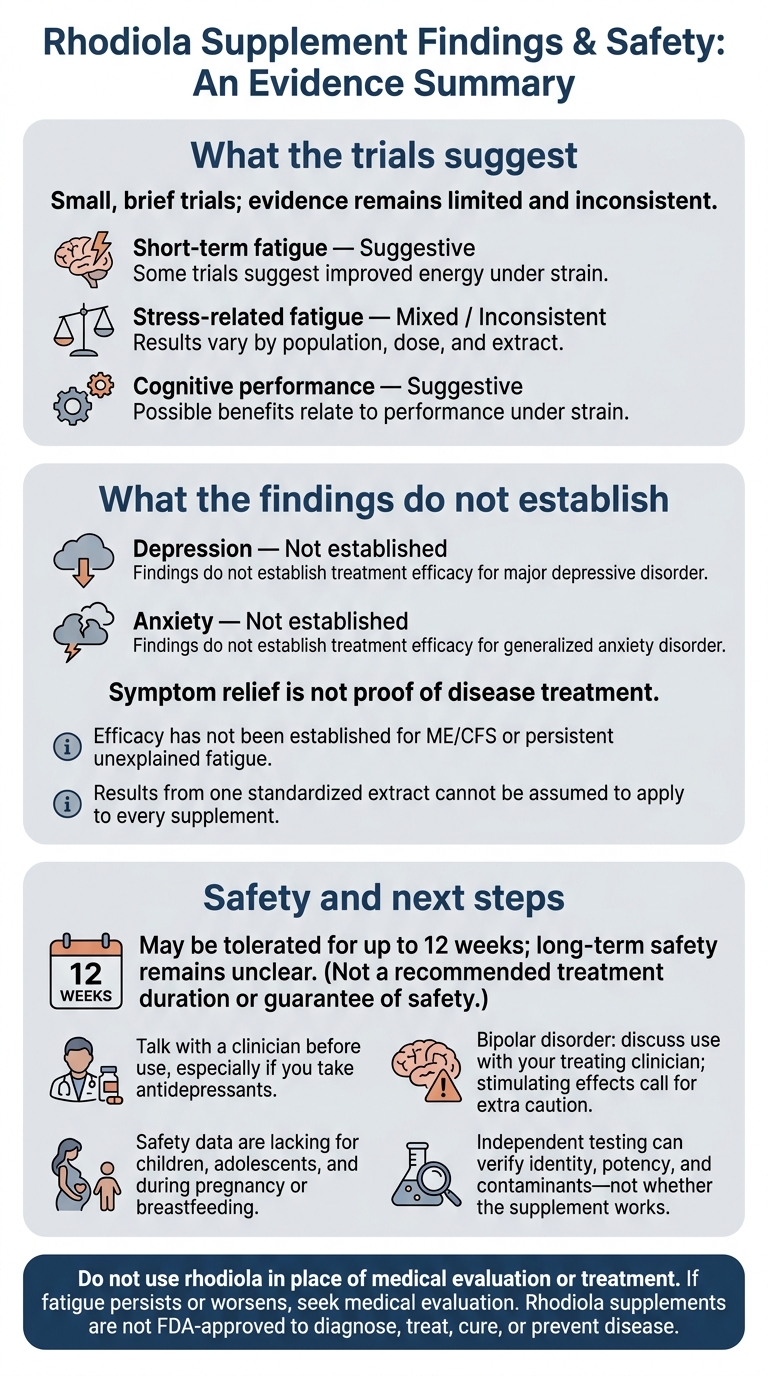
Trials Suggesting Short-Term Improvements
The Four-Week Fatigue-Syndrome Trial
The clearest signal comes from a 2009 randomized trial. It included 60 adults, aged 20 to 55, with stress-related fatigue. For 28 days, half took a standardized rhodiola extract and half took a placebo.
The rhodiola group reported less burnout and fatigue and did better on some attention tests. Their cortisol response after waking also changed. However, mood and depression scores improved in both groups, with no meaningful difference between them.
A change in a biomarker such as cortisol doesn’t prove that symptoms improved. One small, four-week trial also can’t settle the question. Reviews still call for larger, longer trials before anyone can make firm recommendations.
Studies of Work Fatigue, Stress, and Burnout
Studies of work fatigue and burnout show a less consistent picture. A 2012 systematic review of 11 controlled trials found contradictory results for physical and mental fatigue. Every included study had a high risk of bias or unclear reporting.
Some burnout studies had no placebo group. Without one, researchers can’t tell whether improvement comes from the supplement, expectations, or natural recovery. A few positive trials therefore don’t establish that rhodiola helps across these settings.
sbb-itb-23f89d4
What the Trials Do Not Show
Depression, Anxiety, and Other Conditions
Symptom relief is not proof of disease treatment. Research has not established that rhodiola treats major depressive disorder, generalized anxiety disorder, ME/CFS, or persistent unexplained fatigue. Lower symptom scores don’t show that it addresses the cause or prevents future stress.
Depression offers a clear example. In a 12-week trial of adults with mild to moderate depression, rhodiola, sertraline, and placebo showed no significant differences. Sertraline, a common prescription antidepressant, produced somewhat larger improvements. Rhodiola caused fewer side effects.
Its availability as a supplement doesn’t make rhodiola a disease treatment. The FDA doesn’t approve dietary supplements to diagnose, treat, cure, or prevent disease. Symptom changes also don’t prove that rhodiola can replace established care.
Another limit is whether the changes seen in trials apply to fatigue in everyday life.
How Well Do the Findings Apply to Everyday Fatigue?
Healthy volunteers, military trainees, and selected participants with fatigue syndrome do not represent everyone with everyday stress-related fatigue. Some studies used the label fatigue syndrome. That label doesn’t mean participants had myalgic encephalomyelitis/chronic fatigue syndrome (ME/CFS), or that the findings apply to it.
Extracts and doses also differ across products. Results from one standardized extract cannot be assumed to apply to every supplement.
Even modest benefits leave questions about safety, interactions, and product quality unanswered.
Safety, Drug Interactions, and Supplement Quality
Short-term symptom results don’t tell the whole safety story. Rhodiola is possibly safe for up to 12 weeks, but studies don’t establish long-term safety. Short studies can also miss rare harms or problems that take time to appear.
Side Effects and Possible Drug Interactions
Rhodiola can feel stimulating to some people, while others notice a more neutral effect. Reported side effects include dizziness, headache, trouble sleeping, and dry mouth or extra saliva. Researchers have also reported an interaction with losartan, a blood pressure medicine.
Human research on drug interactions remains limited, so talk with a clinician before use, especially if you take antidepressants. Bring the bottle and your full medication list. This advice matters most for people at higher risk.
Who Needs Extra Caution?
There isn’t enough safety data for children, adolescents, or people who are pregnant or breastfeeding. Anyone with a medical or psychiatric condition needs advice tailored to their situation. People with bipolar disorder should discuss rhodiola with their treating clinician before use because its stimulating effects call for extra caution.
Supplement Quality
Safety and quality are separate questions. Check the label for Rhodiola rosea and standardization to rosavins and salidroside. Independent testing can verify identity, potency, and contaminants. However, it can’t show whether the supplement works.
If your clinician agrees you can try rhodiola, decide together which product to use. Also set a check-in date and agree on signs that mean you should stop.
Rhodiola for Fatigue: What the Findings Mean
Research on rhodiola for fatigue supports only cautious claims about short-term use. Small, brief studies suggest it may ease stress-related fatigue, but results vary. Its broader effectiveness and long-term safety remain unproven. Do not use rhodiola in place of medical evaluation or treatment.
If fatigue persists, seek an evaluation rather than treating it yourself.
When Fatigue Needs Medical Evaluation
Persistent or worsening fatigue needs a medical evaluation. A provider can check for causes such as anemia, thyroid dysfunction, or low vitamin D or B12. Depression and anxiety can also cause ongoing fatigue. A provider can review your sleep, mood, medications, nutrition, and activity, then decide whether you need more testing.
What to Bring to a Provider Visit
Bring a timeline of your symptoms, a complete list of medications and supplements, and the rhodiola product label. Discuss possible interactions, realistic goals, and how to track any benefit or side effects.
Symptoms Are Signals. Let’s Find the Source.
Ongoing fatigue often has more than one cause, from sleep and stress to mood, nutrition, and thyroid function. Modyfi’s network of providers looks at the whole person, drawing on mind-body, functional, and integrative medicine. Your provider can order relevant lab work, review your medications and supplements, and screen for depression or anxiety. Together, you can build a plan that targets the source of your fatigue.
👉 Explore Providers to Book an Appointment and Start Your Care Plan
(Note: Modyfi proudly accepts most major commercial insurance plans.)
FAQs
What rhodiola doses have clinical trials studied?
In a 2009 study of stress-related fatigue, adults took 576 mg a day of a standardized extract for 28 days. Other studies used different extracts, doses, and schedules.
These are study doses, not dosing advice. Extracts differ in strength, so the same milligram amount on two labels may not mean the same thing.
Ask a clinician or pharmacist before choosing a product.
How soon might I notice fatigue relief?
There’s no established timeline for fatigue relief with rhodiola. The 2009 study measured results after 28 days, and most studies have lasted weeks rather than months.
If you notice no improvement, or side effects appear, the supplement may not be a good fit. Review your plan with your provider rather than taking more on your own.
How can I tell if rhodiola is helping?
Track the symptoms you hope to change, such as daytime energy, focus, and sleep. A weekly 0 to 10 rating, started before you begin, makes changes easier to see.
Also note side effects, such as trouble sleeping, headache, or dizziness. Share both with your provider at your check-in.
If fatigue worsens or new symptoms appear, contact your provider. Ongoing fatigue can signal a medical or mental health condition that needs evaluation.
Can rhodiola help with depression or anxiety?
Research doesn’t support rhodiola as a treatment for either condition. In a 12-week study of adults with mild to moderate depression, rhodiola didn’t differ significantly from placebo. No comparable studies have tested it for generalized anxiety disorder.
Some people notice small changes in stress or energy. However, those changes don’t amount to treating depression or anxiety.
If low mood or worry lasts for weeks or affects daily life, seek an evaluation. Effective treatments, including therapy and medication, have much stronger evidence.
Is it safe to take rhodiola with antidepressants?
Research on combining rhodiola with antidepressants remains limited. Few studies have tested the combination for safety.
Rhodiola can feel stimulating, which may matter if you take other activating medicines or have bipolar disorder. Your prescriber can weigh these risks against any possible benefit.
Ask your prescriber or pharmacist before combining them. Don’t stop or reduce an antidepressant to try a supplement instead.
Rhodiola vs. ashwagandha: which is better for stress?
Both are adaptogens with limited evidence, but the research focuses on different outcomes. Rhodiola studies mostly look at fatigue and burnout. Ashwagandha studies focus more on stress and sleep.
Neither is a proven treatment for an anxiety disorder or depression. Their safety concerns also differ. Ashwagandha carries rare reports of liver injury and thyroid effects.
Taking both at once makes it hard to tell which one helps or causes side effects. If you want to try either, choose one with your provider first.