


Separation anxiety is normal in babies and toddlers. It becomes a disorder when it lasts too long, feels too intense, and starts to disrupt school, sleep, work, or relationships.
For many parents and adults, the question isn’t just about understanding the symptoms, but knowing when everyday worries cross the line into something more serious. Here is what you need to know about Separation Anxiety Disorder:
- Normal separation anxiety often starts around 8 months, peaks between 10 to 18 months, and often fades by about 24 months
- Separation Anxiety Disorder (SAD) can affect children, teens, and adults
- For diagnosis, symptoms usually last 4+ weeks in children and teens, and 6+ months in adults
- A person must have at least 3 symptoms, such as severe distress at separation, fear that harm will come to a loved one, sleep refusal, or separation nightmares
- About 75% of children with SAD show school-refusal behavior
- About 36.1% of children with untreated SAD still have symptoms in adulthood
What matters most is simple: fear alone is not the issue. The issue is when that fear starts running daily life.
| Topic | Normal Separation Anxiety | Separation Anxiety Disorder |
|---|---|---|
| Age | Mostly infancy to early childhood | Any age |
| Length | Short-term phase | 4+ weeks in kids/teens; 6+ months in adults |
| Intensity | Mild to moderate | Out of proportion to the situation |
| Daily life effect | Usually settles fast | Can lead to missed school, missed work, sleep problems, and strain at home |
| Common signs | Crying at drop-off | Clinging, panic, repeated checking, refusal to be alone, nightmares |
If you or your child cannot function well because of separation fear, it may be time for a mental health evaluation and treatment, often with CBT, and sometimes medication.
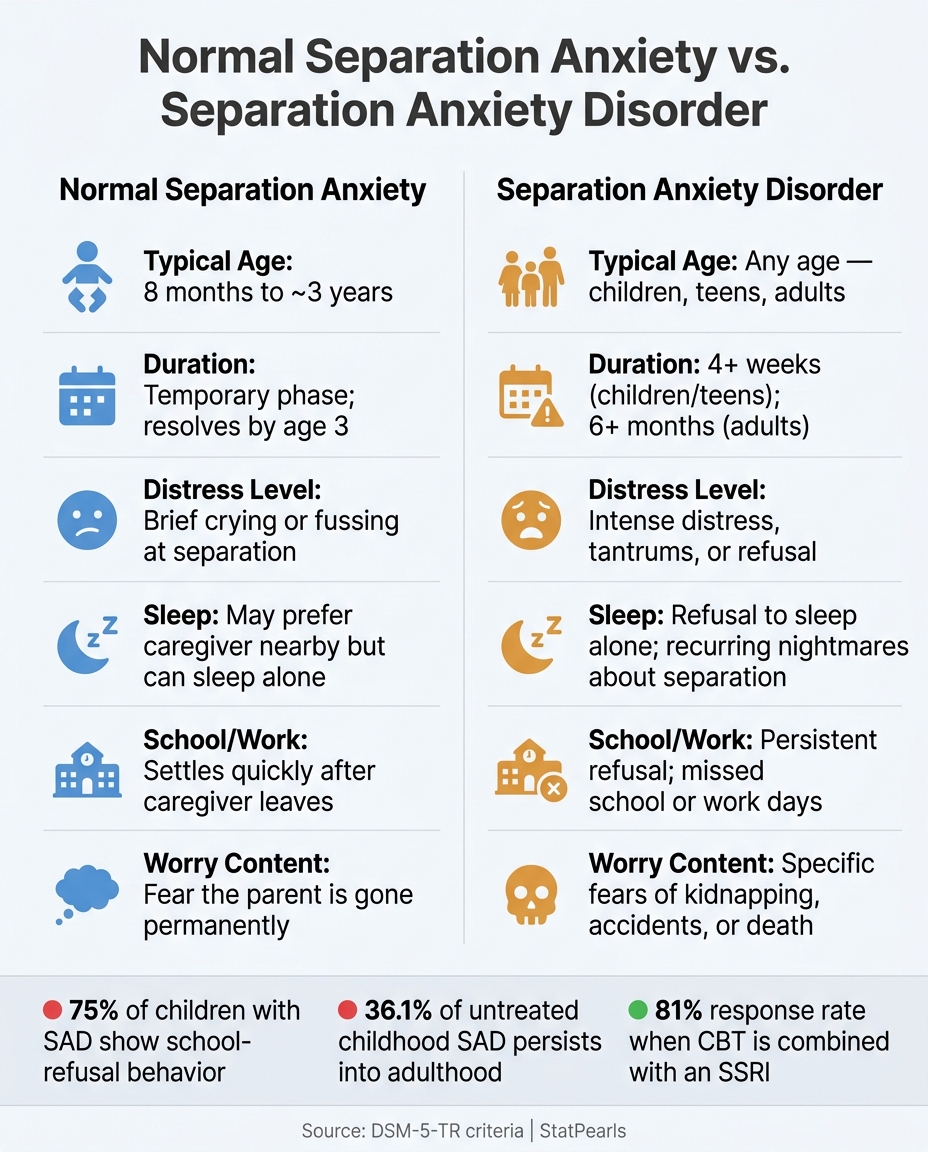
Normal Separation Anxiety vs. Separation Anxiety Disorder: Key Differences
Separation Anxiety Disorder: Causes, Symptoms And Treatment.
sbb-itb-23f89d4
When Does Normal Separation Anxiety Become a Disorder?
The next step is figuring out where a normal phase stops and a disorder starts. That line comes down to duration, severity, and impairment.
Duration and severity standards
Some separation distress is expected, especially in young children. That’s why diagnosis doesn’t rest on fear alone. It depends on how long the symptoms last and how much they interfere with day-to-day life.
According to DSM-5-TR criteria, symptoms must last at least 4 weeks in children and adolescents and 6 months or longer in adults before a diagnosis is considered.
The fear also has to be out of proportion to the person’s age and the actual situation. A toddler who cries at drop-off for a short time may still be within normal development. A child whose fear keeps them from going to school is in a different category. Diagnosis also requires at least three symptoms, such as fear that harm will come to an attachment figure, refusal to sleep away from home or without a caregiver, or nightmares about separation.
“Anxiety becomes pathological when it is so overwhelming that there is persistent distress, a decrease in quality of life, and impairment in regular major life activities.” – StatPearls
Once symptoms cross that line and start disrupting normal routines, a diagnosis becomes more likely.
Signs of Separation Anxiety Disorder in Daily Life
The clearest clue isn’t just the fear itself. It’s the effect that fear has on daily life – what it stops a person from doing.
About 75% of children with SAD show school-refusal behaviors. Other signs can include not being able to sleep alone, missing work, panicking during routine goodbyes, or a family quietly changing its whole schedule to avoid the person’s distress. In adults, it may show up in other ways, like constant checking, problems at work, or strain in close relationships.
Normal separation anxiety vs. Separation Anxiety Disorder: A side-by-side comparison
These differences are often easier to spot when you put them next to each other.
| Feature | Normal Developmental Phase | Separation Anxiety Disorder (SAD) |
|---|---|---|
| Typical age | About 8 months to 3 years | Any age, including older children, teens, and adults |
| Duration | Temporary; resolves by age 3 | 4+ weeks (children and adolescents); 6+ months (adults) |
| Distress level | Brief crying or fussing at separation | Intense distress, tantrums, or refusal |
| Sleep | May prefer a caregiver nearby but can sleep alone | Refusal to sleep alone; recurring nightmares about separation |
| School or work | Settles quickly after the caregiver leaves | Persistent refusal; missed school or work days |
| Worry content | Fear the parent is gone permanently | Specific fears of kidnapping, accidents, or death |
Symptoms and red flags across children, teens, and adults
Once separation fear moves into clinical territory, the pattern is usually pretty clear: intense distress about being apart.
Core symptoms tied to separation
Separation Anxiety Disorder tends to show a familiar group of symptoms across age groups.
The main signs to watch for include:
- Excessive distress before or during separation from an attachment figure
- Persistent worry that something bad will happen to a loved one while apart
- Fear of being alone, even at home or in familiar places
- Refusal to sleep away from home or without the attachment figure nearby
- Recurring nightmares about separation, such as family members being harmed in disasters, fires, or accidents
Physical symptoms can also be part of the picture. These may include stomachaches, headaches, nausea, vomiting, palpitations, and dizziness.
Separation Anxiety Symptoms Across Different Ages
The same fear can show up in very different ways depending on a person’s age.
Younger children may cling to caregivers, trail behind them from room to room, or break down at drop-off when separation is coming. Some children also react with anger or aggression directed at the separation itself.
Teens often hide that fear in less obvious ways. Instead of crying openly, they may refuse school, avoid sleepovers, or keep up constant contact through calls and texts with a parent or caregiver. Social withdrawal is also common.
Adults are more likely to focus that fear on a partner, child, or aging parent. In day-to-day life, it may look like refusing work travel, having trouble sleeping alone, or checking in over and over by phone or text.
| Age Group | Who the Fear Centers On | Key Behavioral Red Flags | Physical Symptoms |
|---|---|---|---|
| Young Children | Parents/caregivers | Clinging, following caregivers, wailing, sleep refusal | Stomachaches, headaches, nausea, vomiting |
| Teens | Parents/caregivers | School refusal, avoiding overnights, repeated calls and texts | Heart palpitations, dizziness |
| Adults | Partners/children/aging parents | Refusal to travel, constant checking, difficulty sleeping alone | Heart palpitations, dizziness |
How Separation Anxiety Disorder is diagnosed and treated
When separation anxiety sticks around, gets stronger, and starts to interfere with daily life, a clinical evaluation can confirm Separation Anxiety Disorder. In plain English, the goal is to figure out whether the fear has moved beyond a normal stage of development and into something that needs treatment.
What a clinical evaluation typically includes
A clinical evaluation is usually done by a licensed mental health professional, psychologist, or psychiatrist. The clinician looks at the person’s symptom history, how long the anxiety has been there, what sets it off, and how much it disrupts day-to-day life. They also look at family context and developmental stage. From there, they assess whether the symptoms are causing problems at school, work, during sleep, or in relationships.
During the evaluation, the clinician may also do a mental status exam. That means they observe behavior, speech, and thought patterns. Standardized screening tools are often used to support the diagnosis, including the Anxiety Disorder Interview Schedule (ADIS), which is considered the gold standard, and the Screen for Child Anxiety-Related Emotional Disorders (SCARED), which is often used with children and parents.
Physical symptoms are common with this disorder, especially stomachaches and headaches. Because of that, a medical evaluation may also be recommended to rule out physical causes before the diagnosis is confirmed.
Once the diagnosis is clear, treatment can begin.
Evidence-based treatment options
Cognitive Behavioral Therapy (CBT) is the main evidence-based treatment for Separation Anxiety Disorder across all age groups. It often lasts about 10 to 15 sessions. The focus is on psychoeducation, changing unhelpful thought patterns, and gradual exposure to separation. In practice, that means the person slowly works on being apart from their attachment figure in a structured, manageable way.
For children, parents are often part of treatment. Parent-supported approaches help caregivers model calm behavior, keep goodbye routines short and consistent, and avoid accidentally strengthening the anxiety. If school refusal is part of the picture, it also helps to coordinate a return-to-school plan with teachers and staff.
For moderate to severe cases, a prescription medication, such as an SSRI (Selective Serotonin Reuptake Inhibitors) may be recommended alongside therapy. Research shows that combining CBT with an SSRI leads to an 81% response rate in children with anxiety disorders, compared with 60% for CBT alone and 55% for sertraline alone.
Care can also be delivered virtually, which can make it easier for people to start treatment and stick with it.
How virtual and integrative care can support recovery
Modyfi Health is a fully virtual clinic that provides psychiatric evaluations, therapy, and medication management for children, adolescents, adults, and older adults. Its integrative model may also look at sleep, nutrition, exercise, and functional lab testing to help identify medical factors that may be contributing to anxiety symptoms.
Conclusion: Key signs to watch for and when to get help
Separation anxiety is normal in early childhood. It becomes a disorder when it sticks around, gets more intense, and starts getting in the way of daily life. The big issue isn’t fear on its own. It’s how long it lasts and how much it disrupts life.
Duration matters, but disruption matters even more. If anxiety is leading to school refusal, work problems, sleep loss, or strain in relationships, that’s enough reason to get it checked out. In plain terms: if it’s affecting day-to-day functioning, a clinical evaluation makes sense.
Ignoring symptoms can let the pattern settle in over time. Clinical studies suggest that about 36.1% of children with untreated SAD continue to have symptoms into adulthood. Untreated cases also increase the risk of later anxiety or mood disorders. In the meantime, academic setbacks, social withdrawal, and family conflict are common.
The good news is that treatment can help children, teens, and adults. Early care may reduce the chance of long-term complications. If these symptoms fit what you or your child are dealing with, the next step is a clinical evaluation. If you need help, Modyfi Health offers virtual psychiatric evaluations, therapy, medication management, and integrated care.
📅 Take the First Step: Schedule a Virtual Evaluation with Modyfi Today
FAQs
How do I know if this is more than a normal phase?
Separation anxiety is a normal part of child development. It often peaks between 8 and 24 months.
That said, it can become a disorder when the fear no longer fits the child’s age, lasts for at least 4 weeks, and clearly disrupts day-to-day life.
Common signs include:
- Intense distress that goes beyond what’s expected for the child’s age
- Refusing school or refusing to sleep away from home
- Constant worry that a parent or caregiver might be harmed
What happens during a separation anxiety evaluation?
A mental health professional looks at the symptoms to see whether they fit the person’s age and stage of development, keep going over time, and cause clear distress. This step usually involves a detailed clinical history based on conversations with the person, their caregivers, or both.
They may also use questionnaires or watch how separation plays out during interactions. To confirm a diagnosis, symptoms must last at least four weeks in children or six months in adults. The symptoms also can’t be better explained by another condition.
Can separation anxiety disorder go away without treatment?
It’s important to tell the difference between normal developmental separation anxiety and separation anxiety disorder.
Normal separation anxiety is a temporary, age-appropriate phase. It usually goes away on its own by age 2.
Separation anxiety disorder is different. It involves excessive, persistent symptoms that disrupt daily life and often call for professional treatment, such as therapy or medication. If symptoms continue, consult a healthcare professional.